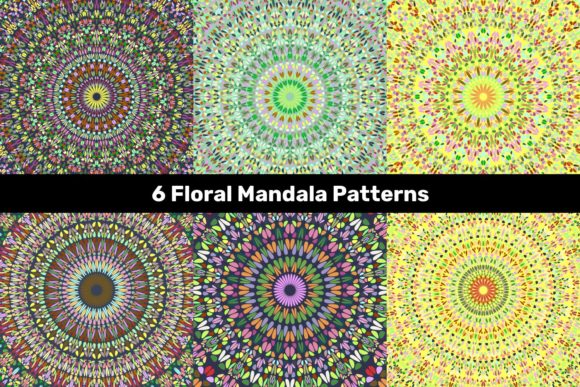
6 Floral Mandala Patterns: A Strategic Resource for Design and Branding
When you work with visual assets day in and day out—whether for branding, marketing, product design, or content creation—the quality and versatility of your source material directly affect your output. The 6 Floral Mandala Patterns package offers a compact but powerful set of resources: six intricate floral mandala designs, each provided in three formats—JPG at a high 5000x5000 resolution, editable vector EPS, and vector AI. That combination of resolution plus native vector editing capability makes this collection more than just a set of decorative motifs. It becomes a practical tool for anyone who needs consistent, scalable, and adaptable design elements.
This article walks through what this package actually contains, why the file formats matter for real projects, and how you can deploy these patterns strategically across different goals—from building a brand identity to streamlining content production. We will also cover common pitfalls when using pre-made design resources and how to avoid them, so you get lasting value rather than just a temporary aesthetic lift.
Understanding What the Package Delivers
The package breaks down into six distinct floral mandala patterns. Each pattern is delivered as a JPG image measuring 5000 by 5000 pixels—a resolution that supports large-format printing and high-detail digital work without visible pixelation. More importantly, the package includes each pattern in both EPS and AI vector formats. Vector files are resolution-independent, meaning you can scale them up or down infinitely without quality loss. This is a critical advantage for professionals who need to reuse a single design across business cards, website graphics, packaging, signage, and large banners without recreating artwork. The vector files also allow you to edit individual elements—change colors, remove petals, adjust symmetry—rather than being locked into a static raster image.
For entrepreneurs and small business owners, this means you are not buying just a pattern; you are buying design flexibility. The same floral mandala can be a subtle watermark on a product label, a hero element in an email header, or a full-bleed background on a brochure. The six variations give you enough range to support a cohesive visual language across multiple touchpoints.
Strategic Uses That Go Beyond Decoration
Many creators pick up floral mandalas purely for their beauty, but the real return comes when you treat them as strategic assets. Here are several goal-oriented ways to integrate the 6 Floral Mandala Patterns into your planning and execution.
Brand Identity Building
If you are developing a brand that wants to communicate elegance, nature, harmony, or craftsmanship, a floral mandala can serve as a core motif or a supporting pattern. Because you have vector files, you can extract a small detail from a large mandala and turn it into a logo mark. Or you can use the full mandala as a repeating pattern on official documents, website backgrounds, or packaging tape. Consistency is vital for brand recognition; having six distinctly different mandalas lets you vary applications while keeping a visual family feel.
Content Production Efficiency
Freelancers, bloggers, and publishers know the value of reusable design templates. With these mandala patterns, you can build a set of branded backgrounds for social media posts, YouTube thumbnails, or podcast cover art. Because you can recolor the vectors in minutes, you can match seasonal or campaign-specific palettes without redesigning from scratch. The high-resolution JPGs are ready to drop into your layout software for print projects like notebooks, greeting cards, or planners. This reduces design time and ensures a polished, professional appearance every time.
Operations and Customer Experience
For small business owners who run physical product lines, consistent packaging and collateral enhance customer trust. Floral mandalas can unify your entire line—from tissue paper and ribbons to stickers and hang tags. Using the 6 Floral Mandala Patterns across your operational materials (invoices, order inserts, thank-you cards) adds a tactile, considered feel that differentiates you from competitors who use generic stock graphics. The vector formats allow you to scale the pattern to fit any object, from a tiny sticker to a large store banner, preserving quality.
When to Use These Patterns and When to Hold Back
A strategic approach means knowing both the strengths and the limits of a resource. These floral mandalas are excellent for projects that need a calm, intricate, or organic aesthetic. They work well for wellness brands, wedding invitations, yoga studios, bohemian product lines, spiritual content, and educational materials on nature or geometry. They also pair nicely with minimalist typography and neutral color schemes.
However, using them without context can backfire. If your brand identity is industrial, high-tech, or oriented toward strict minimalism, a floral mandala might clash. For example, a cybersecurity firm or a mechanical engineering educator would likely confuse their audience by applying floral patterns. Likewise, if your entire communication relies on flat, modern vector illustrations, adding a detailed mandala can feel inconsistent and distract from your core message. The risk is not in the pattern itself, but in misalignment with your broader goals and audience expectations.
Another consideration is overuse. Even a beautiful mandala becomes noise if you plaster it on every piece of content without variation. The six patterns in this package give you enough diversity to rotate among them, but if you need dozens of distinct motifs for a large campaign, you might need a larger library. Evaluate your project scope before committing.
How to Approach Use Intentionally
Random application of design resources rarely yields strong results. Instead, treat the patterns as components of a larger plan. Start by defining the role each pattern will play. Will one be the primary hero graphic? Will another serve as a subtle background texture? A third might become a border or a watermark. Assign specific functions to avoid duplication and maintain hierarchy.
Next, consider color editing. The vector files allow you to change colors globally or per element. If your brand palette has four colors, adapt each mandala to those exact hues. Do not leave the mandalas in their default colors if they do not match your brand. A mismatched color is the fastest way to make a professional asset look cheap.
Also, plan for different media. Use the high-resolution JPG for print and web where vector editing is unnecessary. Use the AI and EPS files when you need to cut, rescale, or combine elements. For instance, you might extract a central flower from a mandala, resize it, and place it over a photograph in a social media post. That flexibility keeps your creative options open without rebuilding from zero.
Practical Planning Tips for Different Roles
The way a marketer uses these patterns differs from how a teacher or a publisher might use them. Consider a few role-specific approaches:
- Entrepreneurs and small business owners can use one mandala as a consistent brand element on all customer-facing materials—receipts, invoices, social media profiles, and packaging. Over time, this repetition builds recognition. Choose the most detailed pattern for premium packaging and a simpler one for digital forms to maintain legibility.
- Freelance designers and creators can source these mandalas as starting points for client projects. Open the AI file, adjust the complexity, change symmetry, or combine two patterns to create a custom design. This saves hours of drawing from scratch while still delivering a bespoke feel.
- Educators and publishers might use the patterns for worksheet borders, certificate backgrounds, or planner covers. The high JPG resolution ensures crisp printing, and the vector files allow resizing to fit any page format without distortion.
- Content marketers and bloggers can create a series of blog post headers or Pinterest pins using different mandalas recolored to match a consistent brand palette. Rotating through all six patterns keeps the feed visually interesting while maintaining uniformity of style.
Risks of Using Mandala Patterns Without Clear Goals
Even a great resource can undermine your work if adopted carelessly. The most common risk is visual clutter: placing a high-detail mandala side by side with busy photographs or dense text can make the entire composition overwhelming. Always check legibility and hierarchy. A mandala background should never make text unreadable. Use opacity adjustments or incorporate the pattern as an accent rather than a full screen.
Another risk is brand dilution. If you use mandalas in one campaign but not in others, or if you use them differently each time, your audience may not form a consistent association. Decide upfront whether these patterns are permanent brand assets or temporary campaign elements. If temporary, note that they are not worth heavy investment in custom recoloring unless you plan to reuse them later.
Finally, avoid the trap of assuming vector format automatically means originality. These patterns are sold as part of a package. Other designers may own the same set. To differentiate, invest time in editing: change colors, rotate elements, crop unique sections, or combine with your own illustrations. Do not simply place a mandala as-is in a client deliverable. That risks looking generic, and it may violate license terms depending on your usage.
Long-Term Value and Integration
The true strategic value of the 6 Floral Mandala Patterns lies in their reusability and adaptability. Over months and years, you can build a library of derived elements—buttons, borders, icons, backgrounds—all originating from these six patterns. If you work in a business that updates its visual identity seasonally (like a boutique hotel or a subscription box service), you can recolor the same mandalas to match new campaigns without needing fresh artwork. This reduces dependency on freelance designers and speeds up production cycles.
For professionals who value efficiency, the combination of high-resolution rasters and editable vectors means you never have to hunt for the right file format at the last minute. You can archive the JPGs for quick use and keep the AI/EPS files for deeper editing. This organization technique alone saves hours per month in design workflow.
Additionally, because the patterns are symmetrical and geometric, they lend themselves to animation and interactive applications. Motion designers can take the vector files and animate the mandala rotations, creating captivating intros or backgrounds for video content. Interactive designers can import the EPS into prototyping tools and add hover effects. The potential expands beyond static print when you think of the mandalas as modular building blocks.
Decision-Making Guidance: Is This Package Right for You?
Before purchasing or relying heavily on the 6 Floral Mandala Patterns, ask yourself these questions:
- Does my brand or project benefit from organic, symmetrical, decorative patterns? If yes, this package is a strong fit.
- Do I have the skills to edit vector files (AI/EPS) or access to software like Adobe Illustrator or CorelDRAW? Without those, you are limited to the JPGs, which still offer high resolution but less flexibility.
- Do I need exactly six patterns, or would a larger set be better? Evaluate your scale. For a small boutique or a personal blog, six variations often suffice. For a large agency with many clients, you might need more diversity.
- Will I take the time to customize the colors and adapt the patterns to my specific uses? If not, the asset may not realize its full potential and could feel impersonal.
- Am I comfortable integrating these patterns with other design elements (typography, photography, icons) in a cohesive layout? Mandala-heavy designs require balanced composition to avoid sensory overload.
Answering these questions honestly helps you decide whether to use the patterns as a primary resource or as a supplemental tool. There is no one-size-fits-all answer, but intentional consideration prevents wasted time and misaligned visuals.
Practical Workflow Ideas to Maximize Outcome
To get the most out of the 6 Floral Mandala Patterns, build a simple workflow. First, open each AI file and apply your brand color palette. Export a set of JPGs in your brand colors right away. Also export some transparent PNGs for digital use. Second, create a template folder: one master file with all six edited mandalas as separate artboards for quick copying into new projects. Third, consider creating simplified versions—maybe half the mandala, or just one petal layer—for small-scale uses like icons or buttons. This extends the utility of the package far beyond the basic six designs.
Also, think about scalability. Because vectors are resolution-independent, you can print a mandala on a 3-foot banner as easily as on a 2-inch sticker. Test the smallest legible size: take a mandala and shrink it to identify at what point details become muddy. Then plan your use accordingly. For very small spaces, use a simplified, less intricate pattern.
Final Thought on Strategic Asset Use
The decision to adopt a pre-made design resource like the 6 Floral Mandala Patterns should never be driven by aesthetics alone. Practicality, alignment with goals, and long-term reusability define whether the investment pays off. When you pair the technical advantages of high-resolution and vector formats with deliberate planning across branding, content, operations, and customer experience, these six patterns become far more than decorative elements—they become multipliers for your creative productivity and brand consistency. The key is intention: know why you are using a mandala, where it fits in your hierarchy, and how it will be maintained over time. That kind of thoughtful approach separates professional work from random decoration.